
Hell breaks loose in Tramin. A large fire sends thick, black smoke billowing through the old alleys. The sound of clanging bells echoes loudly, interrupted only by towering, hairy figures armed with long whips and flaming torches, causing chaos in the village. It is December 5th—Krampus Day.
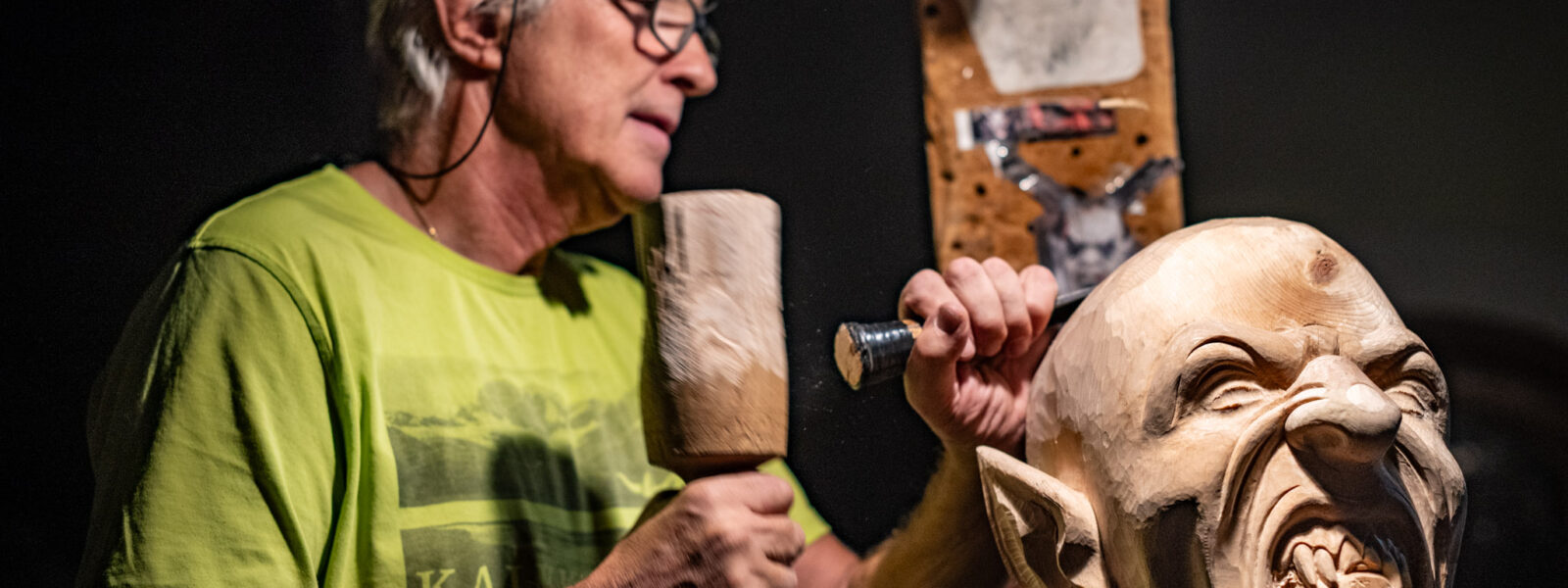
Six months earlier, behind the thick stone walls of a house on Schneckenthalerstraße 4, everything is perfectly quiet. The only sound is the soft ticking of a clock. Here, in his workshop, Walter Maffei stands before a large piece of Swiss pine, carving the eerie faces that will spread fear and terror through the village on Krampus Day. “Wood carving is my absolute dream job,” he says, sweeping some wood shavings aside.
When Walter opened his workshop in Tramin in the early 1980s, the business of decorating large wine barrels for special occasions was booming. Crosses along roadsides, patron saints, and large statues also had a strong tradition back then. “People valued my craftsmanship and would travel from far away to buy it,” Walter recalls.
It wasn’t until twenty years ago that he crafted his first Krampus mask. At that time, interest in traditional craftsmanship suddenly declined. The transition from the Italian lira to the euro had not been kind to the economy. “So, you have to come up with something new,” he says, showing his inventive spirit. He stumbled upon the idea of scary masks purely by chance. Until then, it had not been customary in Tramin to wear wooden masks during the Krampus run. Instead, people disguised themselves with simple fabric masks. The tradition of wooden masks actually comes from Austria. Walter had also encountered it in the Ahrntal valley, where he trained as a young apprentice—an area with a long history of mask carving.
Every Mask is Unique
Der Meister selbst mit seiner eigenen Maske

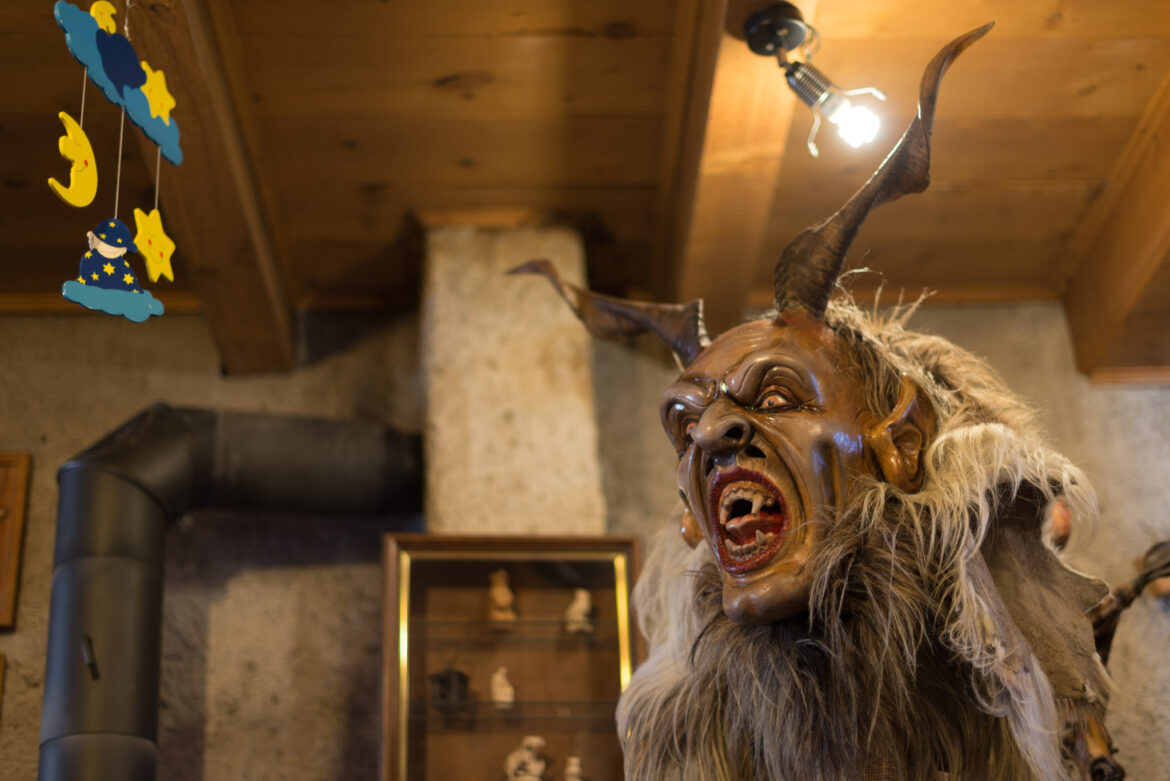
Stepping into Walter Maffei’s small shop feels like entering a chamber of horrors. From every corner, the angry red, green, and blue eyes of the Krampuses glare at you. Large horns protrude from their wooden heads, and some figures even stick out their tongues. “I try to carve my masks in a very traditional way,” Walter explains, “just as one imagines the devil.” He wants nothing to do with zombies, aliens, or skulls. A Krampus, in his view, should always be a terrifying image of the devil, whose job is to punish misbehaving children. The well-behaved ones, on the other hand, are rewarded by Saint Nicholas.
The Advent tradition of the Krampus is celebrated not only in South Tyrol but also in other parts of northern Italy, as well as Bavaria, Austria, Hungary, Slovenia, Slovakia, Liechtenstein, and Croatia.
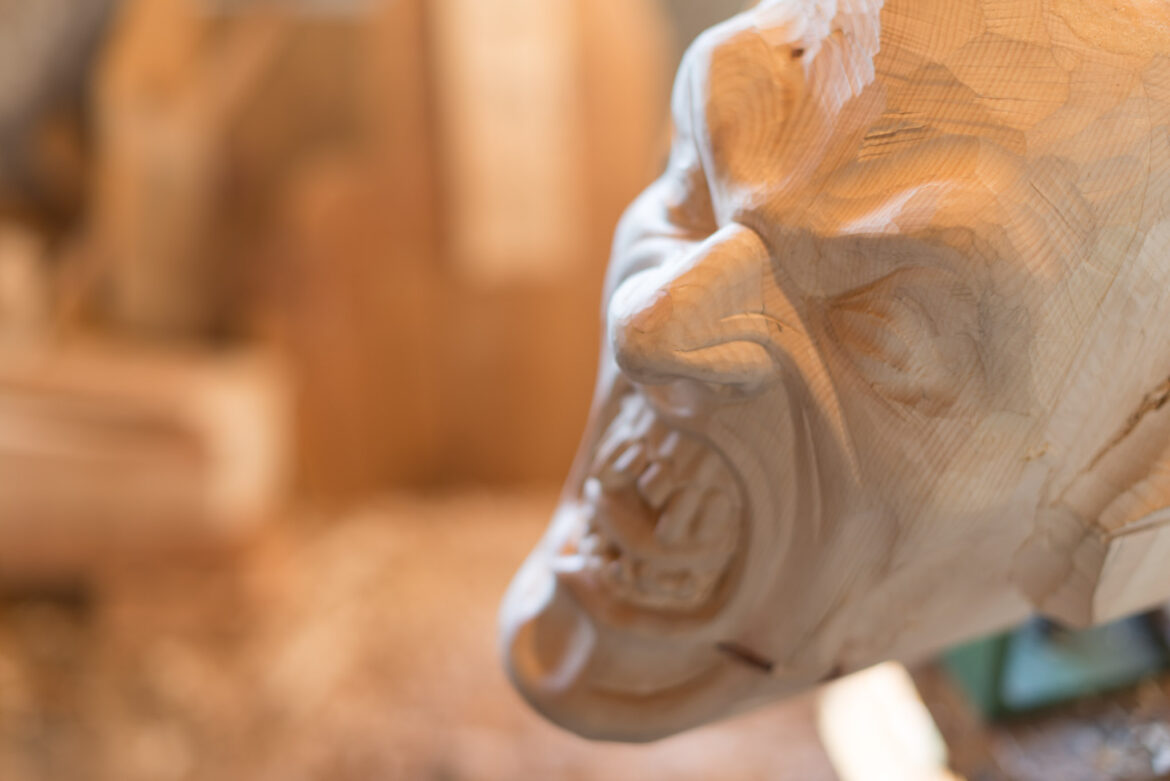
It takes about two weeks for a block of Swiss pine to become a finished Krampus mask. Walter begins by roughly shaping the contours of the face from the wood. After an hour, the first facial features of the Krampus become visible. Next, the block is hollowed out and split into two halves. Depending on the customer’s request, every detail is then meticulously carved into the Krampus’ face. “Some customers even want a Krampus that looks like an evil version of themselves. Such requests require a lot of skill,” Walter explains. Wide-open mouths with long tongues, glowing eyes, and eyebrows made from chamois hair complete the devilish look. And, of course, the long horns on the head are a must.
Like a tailor fitting a wedding dress, the mask is repeatedly tested for fit, adjustments are made, the inside is lined with foam and leather, and it is perfectly tailored to the owner’s head. Although Swiss pine is the lightest wood and therefore ideal for mask making, the wild Krampuses still carry between 2.5 and 5 kilograms (5.5–11 lbs) of weight on their heads. “By the end of the run, you’re drenched in sweat,” Walter says with a grin. As a mask carver, he naturally takes part in Tramin’s wild festivities himself and knows all too well the challenges behind such a spectacle. Since the Krampus’ eyes are almost hidden within the mask, visibility is limited. “Especially in the dark, it’s hard to find your way. You have to fix your gaze on your target first and then run,” Walter explains, recalling a few accidents during his early runs.
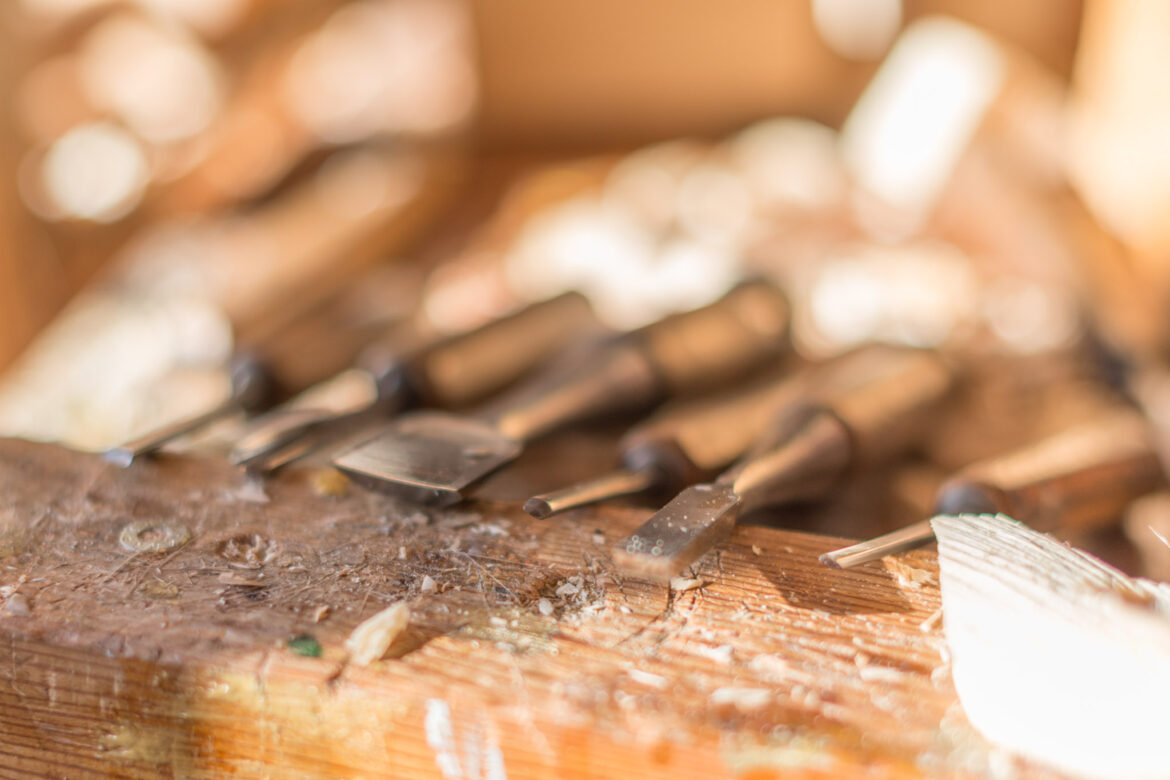
His customer base now extends all the way to Bavaria and Trento. Among them are collectors and, of course, those who take part in parades themselves. From March to September, Walter’s carving workshop is open only by appointment, as he works in a company in Tramin during this time. The rest of the year, he spends every day carving the many Krampus masks that are ordered from him. What brings him the most joy is seeing his customers happy with the final result. After all, a Krampus mask costs between 600 and 800 euros.
Walter’s biggest competition comes from workshops in Eastern Europe, where machines are used to mass-produce cheap wooden blanks for masks. But the master carver is unimpressed by these methods. “Wood carving is and always will be a craft. In my workshop, every step is done by hand,” he says proudly.
Now and then, Walter also carves during Tramin’s “Long Wednesdays.” Visitors can watch live as a simple piece of Swiss pine is transformed into a Krampus mask.
(Text by Lisa Maria Kager)
Where Walter’s masks are used – and where they are not!
Of course, a mask is a must at the Traminer Krampus parade. Traditionally, black fabric masks with red fabric horns were common in Tramin, but nowadays, most Krampuses wear Walter’s devilishly beautiful wooden masks. However, at the Traminer Egetmann parade, masks are an absolute no-go. Only a select few characters are allowed to wear masks at this traditional carnival procession.
Walter Maffei
Schneckenthalerstraße 4
39040 Tramin
walter.maffei58@gmail.com
+39 0471 860551
Accommodation in Tramin
Ads
Available accommodation
 Gartenheim. Quiet, central, breakfast under vines, pool & gar...
 Urbanhof. Quiet place with pool.
 Hotel Pernhof. Suites & Apartments, restaurant, sauna
 Goldene Traube, Panorama & Überbacherhof. B&B, apart., re...
 Vineus. New! Appartments, suites and rooms