
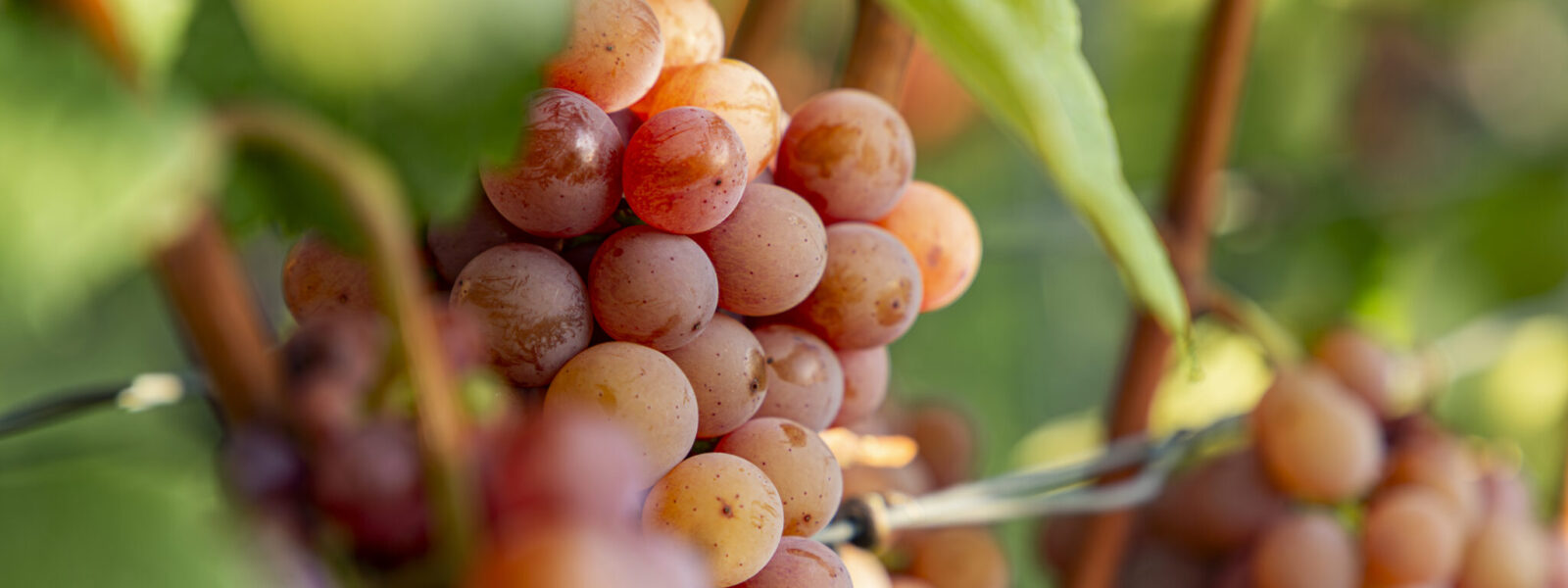
Gewürztraminer is one of the oldest and most aromatic white grape varieties in the world.
Even its name evokes notes of spices and floral aromas – and indeed, no other wine releases such an intense bouquet.
Typical aromas include rose petals, exotic fruits such as lychee and spicy notes, for example cloves. This extraordinary aromatic richness is due to the high concentration of aromatic compounds (especially terpenes) found in the grape skins, which define its unmistakable bouquet.
Once highly valued in medieval Europe, this grape variety is now experiencing a revival as a cult wine for connoisseurs, captivating both experts and newcomers to the world of wine.
Table of content
Appearance, aromatic compounds and skin colour
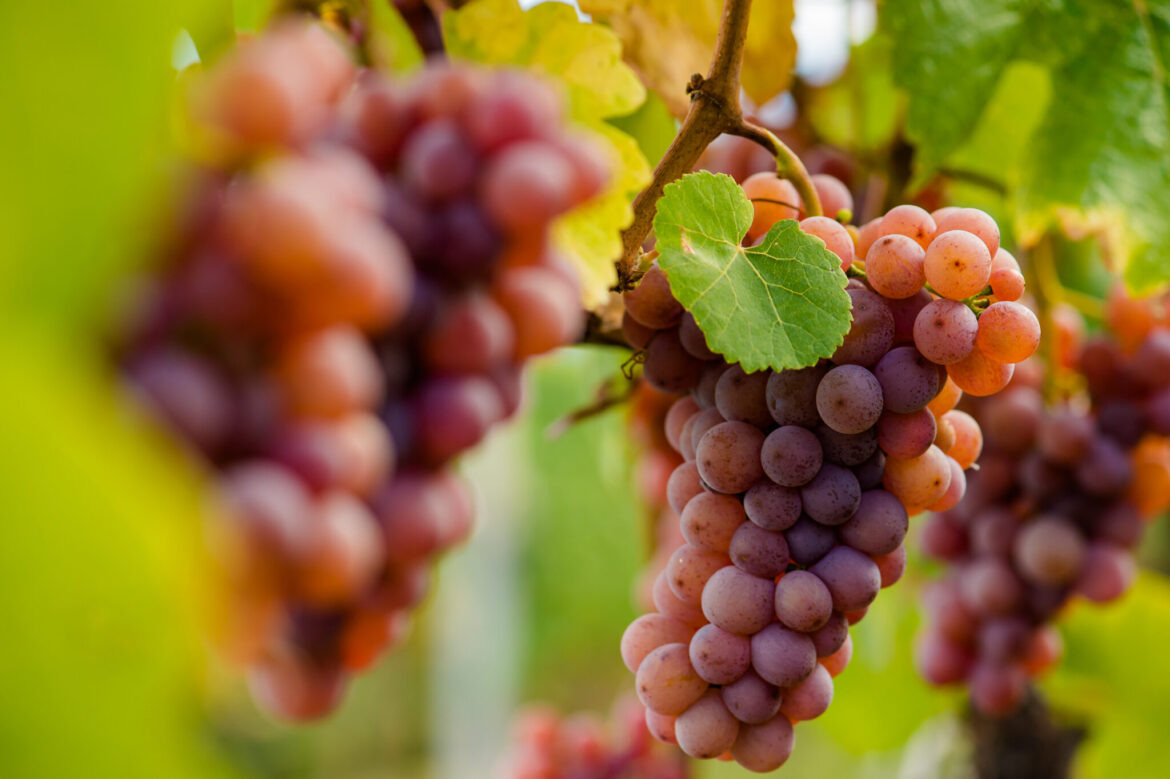
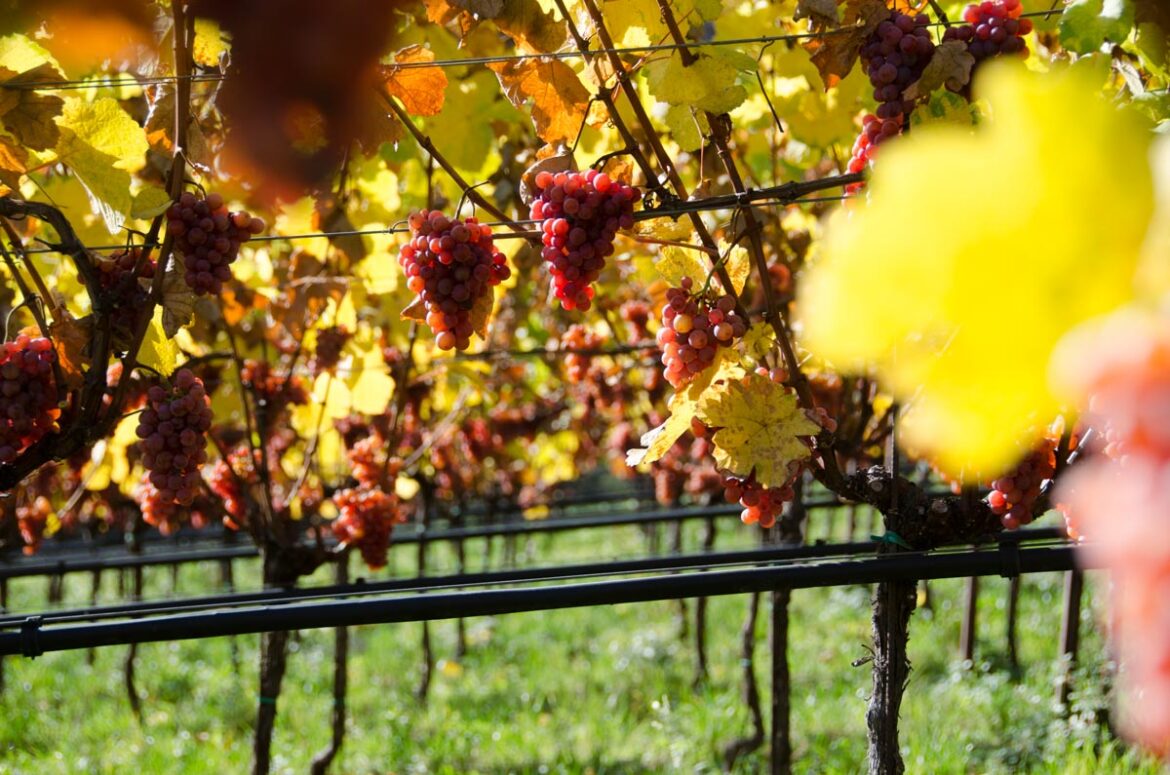
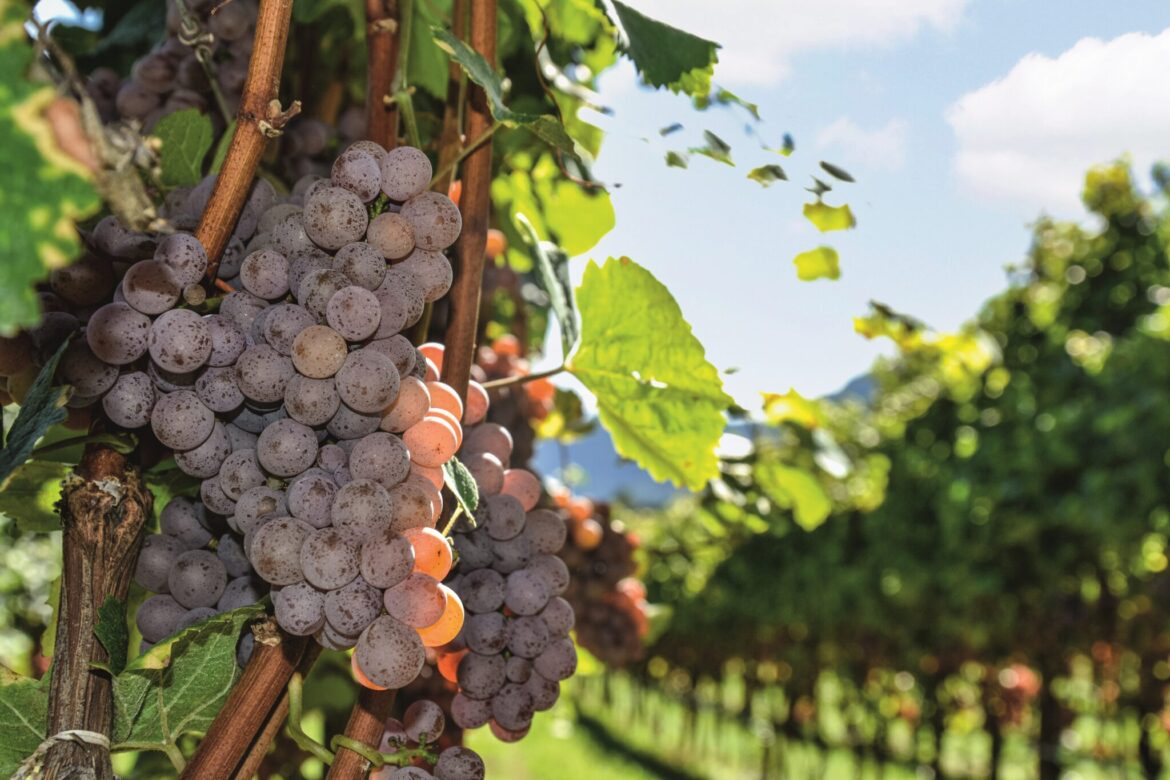
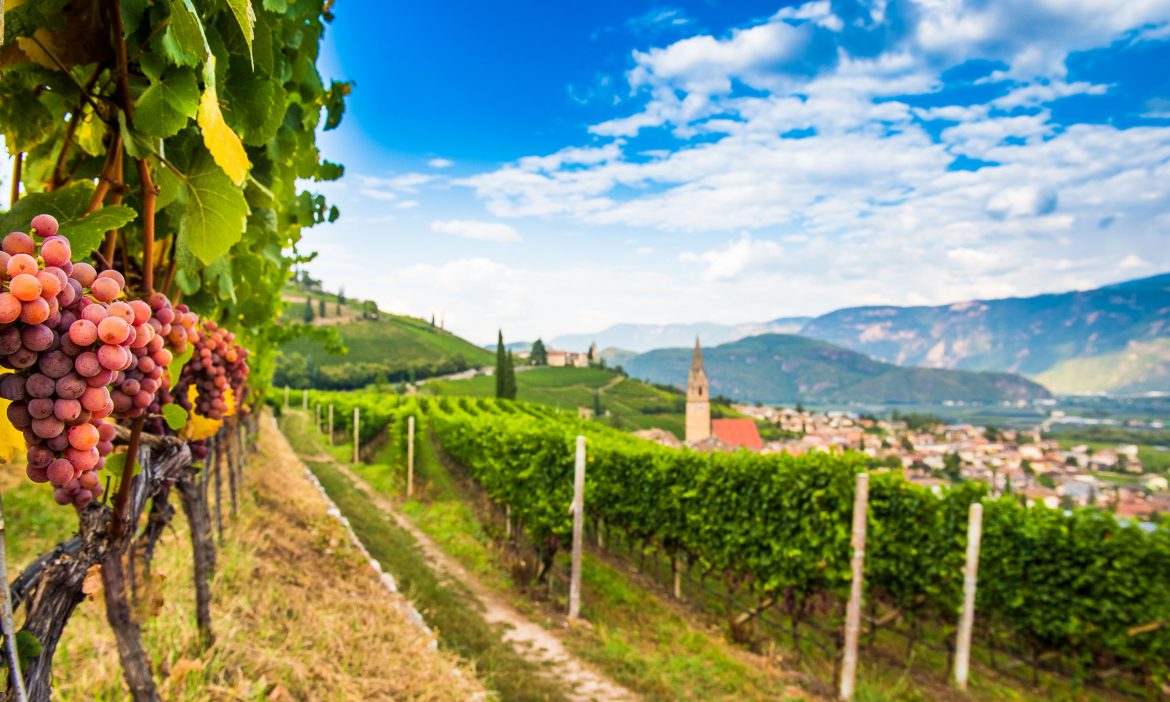
Gewürztraminer grapes are easily recognizable already on the vine. The bunches and berries are generally small, with thick skins and a distinctive coppery-pink colour with slight greyish hues. This is also the origin of the name “Roter Traminer” (Red Traminer), referring to the reddish-brown colour of the skin.
Compared to many other white grape varieties, Gewürztraminer berries appear almost pink or slightly red, creating particularly picturesque impressions in the vineyard. The flesh is firm, very sweet and low in acidity, characteristics that later give the wines a soft and full-bodied structure.
However, this variety tends to coulure during flowering (incomplete fertilisation), resulting in low yields: often a vineyard produces only about half the usual yield per hectare. This natural limitation enhances the quality of the grapes, leading to greater aromatic concentration and higher sugar levels.
Even when simply observed or gently crushed, the grapes release their intense aroma. The thick skin contains numerous essential oils and aromatic compounds.
A typical hallmark is the unmistakable scent of roses – often described as the perfume of dried rose petals – combined with exotic fruit notes (especially lychee, but also passion fruit or bitter orange) and a hint of sweet spices. This rich aromatic profile makes Gewürztraminer a classic aromatic grape variety.
Chemical analyses have also shown that Gewürztraminer wine and lychee share very similar aromatic compounds – one reason why many people immediately associate the wine with lychee upon first smell or taste. In the glass, Gewürztraminer wines range from deep straw yellow to golden yellow and, depending on the ageing, can be more subtle or highly expressive, yet always unmistakable.
Traminer, Red Traminer, Gewürztraminer
From a genetic perspective, Gewürztraminer belongs to the Traminer family, one of the oldest grape lineages in the world.
Modern DNA analyses show that Traminer (also known as Savagnin) was already widespread in Europe over a thousand years ago and is considered an original variety derived from a natural selection of wild vines.
Grape seeds dating back around 900 years have indeed been identified as being genetically almost identical to today’s Traminer/Savagnin. Traminer can therefore be regarded as a true ancestor in the genetic heritage of numerous grape varieties: it is, for example, a confirmed parent of Silvaner and also an “ancestor” of Riesling.
Through complex crossings, Traminer has also indirectly contributed to Sauvignon Blanc and, consequently, to Cabernet Sauvignon. It can therefore be stated without exaggeration that Traminer represents a foundational variety within the genealogy of many renowned grape varieties.
Within the Traminer group, there are several variants, which differ mainly in berry colour and aromatic intensity. From an ampelographic point of view (i.e. based on visible characteristics), these variants are almost identical and are considered the same variety, with slight mutations.
Three main colour variants can be distinguished
Berries with a reddish-brown colour and a more delicate aromatic profile. This traditional form, often simply referred to as Traminer, yields slightly higher production but a less pronounced aroma.
Berries ranging from light red to pinkish hues; an aromatic mutation of Red Traminer. It is characterised by an especially intense and spicy bouquet – hence the name “Gewürz” – but produces lower yields. Gewürztraminer is, in every respect, the most expressive representative of the Traminer family.
Berries of a yellow-green colour, also known as Yellow or White Traminer. This variant corresponds to Savagnin Blanc, which is widespread in France, particularly in the Jura region for the production of Vin Jaune. Interestingly, wines made from Savagnin Blanc have a completely different aromatic profile – lacking the typical intensity – due to the oxidative winemaking style and local clonal selections.
All these variants belong botanically to the same grape variety. Gewürztraminer is therefore not a distinct species, but rather the most aromatic expression of the Traminer group.
As ampelographers point out, Red Traminer and Gewürztraminer cannot be distinguished visually: the former produces higher yields with less aromatic intensity, while the latter stands out for its intense bouquet combined with lower yields.
In practice, many of these variants are today marketed under the name Gewürztraminer, as this designation immediately conveys its characteristic aromatic profile.
From a genetic perspective, Gewürztraminer is also closely related to the Pinot family: DNA analyses suggest a shared origin, although it remains unclear which variety came first.
This once again highlights the great age and importance of Traminer: it is believed to have been known as early as Roman times and may even be referenced in the Latin term Vitis aminera.
In summary, Traminer is an ancient grape variety, a true legend of viticulture, whose aromatic mutation – Gewürztraminer – continues to captivate today with its unique character.
Origin of the name and synonyms
The term Traminer clearly refers to the South Tyrolean village of Tramin (Italian: Termeno) along the Wine Road.
As early as the Middle Ages, this grape variety was present in this area, and the wines of Tramin enjoyed great prestige. It is therefore likely that the wine trade from Tramin contributed to the naming of the variety: “Traminerwein (wine from Tramin)” was already, from the 13th century onwards, a well-established term in the German-speaking world.
A document from Tramin dating back to around the year 1.000 A.D. already mentions a Traminer vineyard, although it remains uncertain whether it was genetically identical to today’s Gewürztraminer. However, by 1470 the identity is clearly established: in that year, Duke Sigismund of Tyrol donated four barrels of the finest Traminer wine from Tramin to the church as liturgical wine.
Traminer was considered a noble wine, but also a powerful one: in 1546 the botanist Hieronymus Bock praised the variety in his herbal book, while in 1593 the scholar Alberti warned women against consuming too much of this robust wine. Such anecdotes underline the reputation Traminer already held in the early modern period as a “wine for princes and connoisseurs.”
The term Gewürztraminer came into use only at a later stage.
The designation “Gewürz-” – meaning “spiced” or “aromatically scented” – was established to distinguish the particularly aromatic variant from the traditional Traminer. Interestingly, the name Gewürztraminer first appeared only towards the end of the 19th century in Alsace. At that time, Alsace-Lorraine belonged to Prussia/Germany, which is why the German term entered the wine lexicon. The aromatic mutation (Gewürztraminer) likely originated already in the 18th century in this region, but only became widely known under this name.
Today, “Gewürztraminer” has become internationally established: even in France the term is used (often written without the umlaut as Gewurztraminer), and in Italy it is officially recognized as Traminer aromatico.
Few grape varieties have as many synonyms and local names as Traminer/Gewürztraminer. In official German registers, the variety is listed as Red Traminer, while approved synonyms on labels include Gewürztraminer and Yellow Traminer. In Baden, the historical name Clevner is also used.
In South Tyrol, it is referred to as Traminer Aromatico or simply Gewürztraminer. In France, the lighter variant is known as Savagnin Blanc (White Traminer), while the rosé-coloured one is called Savagnin Rose – in a village in Alsace, the latter is marketed as Klevener de Heiligenstein, a less aromatic Traminer variant.
In Switzerland, particularly in the Valais, the variety is known under traditional names such as Heida or Païen, while in southeastern Europe names like Traminac are common. This wide range of synonyms reflects the extensive distribution and long naming history of the grape variety. Whether referred to as Traminer, Savagnin or Gewürztraminer, it is always the same fascinating grape, which, with its aromatic richness and captivating fragrance, holds a unique place in the world of wine.
Accommodation in Tramin
Ads
Available accommodation
 Gartenheim. Quiet, central, breakfast under vines, pool & gar...
 Vineus. New! Appartments, suites and rooms
 Hotel Pernhof. Suites & Apartments, restaurant, sauna
 Goldene Traube, Panorama & Überbacherhof. B&B, apart., re...
 Urbanhof. Quiet place with pool.